The Best Supplements for Beginners — A Complete Starter Guide
The best supplements for beginners are not the most exciting ones on the shelf — they are the evidence-based fundamentals that address the nutritional gaps most people actually have, at doses that actually work. The supplement industry is expert at selling complexity to beginners, when the research consistently shows that a small number of well-chosen, correctly dosed supplements delivers the vast majority of available benefit. This guide cuts through the noise.
The Most Important Principle for Supplement Beginners — best supplements for beginners
Start with what you are actually deficient in — not what is most heavily marketed. The two most prevalent, most impactful, and most correctable nutritional deficiencies in the Western adult population are vitamin D and magnesium. These two supplements alone, chosen well and dosed correctly, will outperform most expensive “advanced” supplement stacks for the majority of beginners. Everything else builds from this foundation.

Stop Guessing. Start Tracking What Works.
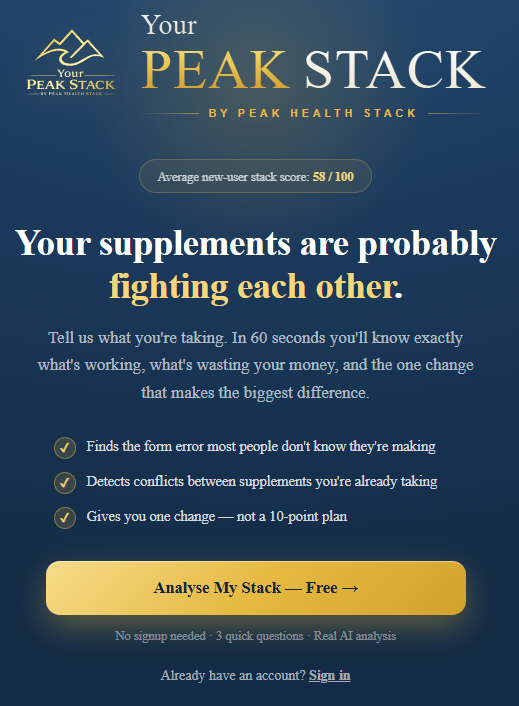
Your Peak Stack helps you log your supplements, track how you actually feel, and get AI-powered guidance on what’s helping, what may be clashing, and what to adjust next.
Supplement 1: Vitamin D3 + K2 — Start Here — best supplements for beginners
Vitamin D deficiency affects an estimated 40-50% of adults in northern Europe and northern North America. The symptoms of deficiency — fatigue, low mood, poor immune function, muscle weakness, disrupted sleep — are easily missed because they are non-specific and develop gradually. Supplementing vitamin D3 in a combination product with K2 (MK-7 form) addresses the deficiency efficiently: D3 corrects the vitamin D status and K2 ensures the increased calcium absorption is directed to bone rather than arteries. A quality D3 + K2 combination supplement at 2,000-4,000 IU D3 daily with a fat-containing meal is the single highest-return supplement for most beginners.
The best supplements for beginners address actual deficiencies — not what is most heavily marketed in the supplement industry.
PHS VERIFIED PICK
Nutricost Vitamin D3 + K2
WHY WE PICKED THIS:
Evidence Score: 4.5/5 | 31 RCTs
Typically £12-16 · 120 capsules · 4-month supply at 1 per day
We earn a small commission on this link. It never affects which products we recommend.
Supplement 2: Magnesium Glycinate — Sleep and Recovery
Magnesium is involved in over 300 enzymatic processes. It is depleted by chronic stress (which accelerates renal excretion), poor diet (modern food processing strips magnesium from foods), and high exercise volumes. The consequences of deficiency are broad: disrupted sleep, increased anxiety and stress reactivity, muscle cramps and poor recovery, blood pressure dysregulation, and impaired energy metabolism. Magnesium glycinate at 300-400mg before bed is the best-absorbed, best-tolerated form with the strongest evidence for sleep and anxiety benefits. This is the supplement most likely to produce a noticeable difference in how you feel within 1-2 weeks.
PHS VERIFIED PICK
Thorne Magnesium Bisglycinate
WHY WE PICKED THIS:
Evidence Score: 4.2/5 | 23 RCTs
Typically £12-16 · 120 capsules · 2-month supply
We earn a small commission on this link. It never affects which products we recommend.
Supplement 3: Omega-3 (EPA + DHA)
Omega-3 fatty acids — specifically EPA and DHA from fish or algae — are consistently under-consumed in Western diets unless oily fish is eaten 3+ times per week. EPA reduces chronic inflammation (which underlies cardiovascular disease, joint pain, and metabolic dysfunction), DHA is essential for brain structure and function, and both support mood, recovery, and cardiovascular health. The evidence base for omega-3 spans thousands of clinical studies across decades — it is one of the most thoroughly researched supplements available. Quality omega-3 EPA + DHA at 1,000-2,000mg daily with a meal is appropriate for almost everyone as a dietary gap-filler.
The best supplements for beginners list is deliberately short: vitamin D, magnesium, and omega-3 cover the most prevalent gaps.
PHS VERIFIED PICK
Nordic Naturals Ultimate Omega-3
WHY WE PICKED THIS:
Evidence Score: 4.3/5 | 27 RCTs on cardiovascular health + depression in women
Typically £22-28 · 60capsules · (30 days at 2 caps/day)
We earn a small commission on this link. It never affects which products we recommend.
Supplement 4: Vitamin B12 — If You Are Plant-Based or Over 50
Vitamin B12 is found almost exclusively in animal products. Vegans, vegetarians, and adults over 50 (who have declining gastric acid and intrinsic factor production needed for B12 absorption) are at meaningful risk of deficiency. B12 deficiency develops slowly but produces profound consequences: fatigue, cognitive decline, mood changes, and neurological symptoms that can become irreversible if untreated. Methylcobalamin sublingual tablets are the recommended form — bypassing the absorption issues that create deficiency in the first place.
PHS VERIFIED PICK
Jarrow Formulas Methyl B-12 1000mcg
WHY WE PICKED THIS:
Evidence Score: 4.0/5 | 18 RCTs
Typically £8-12 · 100 tablets · 3-month supply
We earn a small commission on this link. It never affects which products we recommend.
Supplement 5: Creatine Monohydrate — If You Train
Creatine monohydrate is the most comprehensively researched sports supplement in existence. At 5g daily, it increases phosphocreatine stores in muscle, allowing more power output and training volume, which translates to greater muscle and strength gains over time. It is safe, effective, and inexpensive. Creatine monohydrate at 5g daily is appropriate for anyone doing resistance training, interval training, or any sport involving explosive efforts. No loading phase required — simply take 5g daily at any time.
PHS VERIFIED PICK
Creapure Creatine Monohydrate
WHY WE PICKED THIS:
Evidence Score: 4.3/5 | 25+ studies on injury recovery + immobilisation
Typically £8-12 · 500g capsules · (100 servings at 5g/day = 100 days)
We earn a small commission on this link. It never affects which products we recommend.
What Beginners Should Avoid
Proprietary pre-workout blends: These are primarily caffeine with unproven additional ingredients at sub-therapeutic doses wrapped in impressive branding. Buy caffeine directly if you want a pre-workout stimulant — it costs a fraction of the price and delivers the same (or better) effect.
Starting with the best supplements for beginners means building a nutritional foundation before adding anything more targeted.
Fat burners and metabolism boosters: The thermogenic effect of caffeine and green tea extract is real but modest (~50-100 extra calories per day). Everything else in these products is marketing. No supplement meaningfully accelerates fat loss beyond the basics.
Testosterone boosters: For men under 40 with normal testosterone levels, no supplement produces meaningful testosterone elevation. The compounds that do affect testosterone (zinc, vitamin D, magnesium) are already in the foundation stack above.
Excessive multivitamins as a primary strategy: Multivitamins deliver all nutrients at inadequate doses in poorly absorbed forms. Targeted supplementation of actual deficiencies is significantly more effective and comparable in cost.
How to Build Your First Supplement Stack
Month 1: Vitamin D3 + K2, magnesium glycinate. Give these 4 weeks to establish baseline levels before evaluating how you feel. Month 2: Add omega-3 EPA + DHA. Month 3: If plant-based or over 50, add methylcobalamin B12. If training consistently, add creatine monohydrate. Beyond month 3: evaluate specific symptoms or goals (iron if fatigue and periods are heavy; collagen if joint health is a concern; zinc if immunity or skin are priorities) with testing guidance where relevant.
Frequently Asked Questions
Do I need supplements if I eat well?
Possibly not for everything, but probably for vitamin D. Even people eating genuinely excellent diets in northern climates cannot synthesise enough vitamin D from sun exposure during winter months. Omega-3 sufficiency requires consistent oily fish consumption that most people do not maintain. And magnesium insufficiency persists in many people eating varied diets due to soil depletion and stress depletion. A blood test for vitamin D and ferritin (stored iron) is the most valuable first investment — not a supplement purchase.
How do I know which supplements I actually need?
Testing: get a blood test for vitamin D (25-hydroxyvitamin D), ferritin (stored iron), and if relevant B12. These three tests identify the most common, most impactful correctable deficiencies. Everything beyond these three is either universal (omega-3 unless you eat oily fish 3x/week) or targeted to specific symptoms or goals.
When is the best time to take supplements?
Vitamin D3 + K2: with a fat-containing meal (morning or lunch). Magnesium glycinate: before bed. Omega-3: with any meal containing fat. B12: morning. Creatine: any time — consistency matters more than timing. Separate iron from calcium by 2+ hours if taking both.
Are expensive supplements better?
Not necessarily. Form matters more than brand. Magnesium glycinate outperforms magnesium oxide regardless of price. Methylcobalamin outperforms cyanocobalamin. Ubiquinol outperforms ubiquinone for CoQ10 over 40. Within the right form category, mid-range reputable brands are typically equivalent to premium brands. Third-party testing certification (NSF, USP, Informed Sport) is a more reliable quality indicator than price.
Can I take all my supplements together?
Most supplements can be taken together without significant interaction concerns. Key exceptions: iron should be separated from calcium and zinc by 2+ hours as they compete for absorption. Magnesium is best taken in the evening away from the rest of the stack. Everything else can typically be taken simultaneously with a meal.
Starting Simple and Building From Evidence
The best supplements for beginners are the ones addressing actual deficiencies, at therapeutic doses, in bioavailable forms. Vitamin D3 + K2, magnesium glycinate, and omega-3 are the evidence-based starting points for most adults. Add creatine if you train. Add B12 if you are plant-based or over 50. Test before adding anything more specific. For comprehensive supplement guides covering every ingredient in detail, visit peakhealthstack.com.
Stop Guessing Which Supplements Are Actually Working.
Your Peak Stack helps you log your supplements, track how you feel, and get AI-powered insights on what’s helping, what may be wasting money, and what to adjust next.
Related Guides on Peak Health Stack
- Best Magnesium Supplement
- Vitamin D Deficiency Symptoms
- Best Omega-3 Supplements
- Does Creatine Actually Work?
Stop Guessing Which Supplements Are Actually Working.
Your Peak Stack helps you log your supplements, track how you feel, and get AI-powered guidance on what is helping, what may be clashing, and what to adjust next.